· Reviewed by Nimra Khalid
What are prior authorization services?
Prior authorization services handle the administrative work of getting a payer's approval before a procedure, medication, equipment or ongoing service is delivered. A dedicated agent gathers clinical documentation, submits the request through the payer's portal or fax, follows up until a decision is issued, and records the authorization number, units and dates so claims bill within approved scope.
-
Prior authorization: what we do and how it runs
Prior authorization services handle the administrative work of getting a payer's approval before a procedure, medication, equipment or ongoing service is delivered. A dedicated agent gathers clinical documentation, submits the request through the payer's portal or fax, follows up until a decision is issued, and records the authorization number, units and dates so claims bill within approved scope.
01 / 06 -
What it is
Prior authorization services handle the administrative work of getting a payer's approval before a procedure, medication, equipment or ongoing service is delivered. A dedicated agent gathers clinical documentation, submits the request through the payer's portal or fax, follows up until a decision is issued, and records the authorization number, units and dates so claims bill within approved scope.
02 / 06 -
What you get
Authorizations requested, chased and documented before the service date
03 / 06 -
How it runs
Payer follow-up by portal and phone until a decision is on file
04 / 06 -
Billing audit call
We review your payer mix, the services that need authorization, current turnaround times and your no-authorization denial history. A BAA is signed before any patient information is shared.
05 / 06 -
A named accountant, a backup and a team lead
Inside your own software, on a fixed close calendar, with a reply from a person within 1 business day. Call +1-657-777-0006 or start a quote.
Book a billing audit 06 / 06
Who it is for
Medical, dental and behavioral health practices
Clinical staff spend hours on payer hold instead of with patients. A dedicated authorization agent submits, follows up and documents so the clinic runs on approved visits.
Home care, DME and NEMT providers
Ongoing services need initial auths, re-auths and unit tracking. The agent watches expiry dates and units used, and starts renewals before coverage lapses.
Practices with high denial rates for no authorization
If 'authorization missing' is a top denial reason, the fix is upstream. A tracked auth process closes that gap and feeds the claim with the right number.
What's included
- Authorization requirements checked per payer and service code
- Requests submitted through payer portals, fax or phone as each payer requires
- Clinical documentation requested from providers with a checklist per payer
- Follow-up calls and portal checks until a decision is issued
- Peer-to-peer review requests scheduled with your clinician when needed
- Authorization number, units, dates and limits written on the patient account
- Expiring authorizations tracked and renewals started ahead of time
- Units used against units approved monitored for ongoing services
- Denied requests logged with reason and handed to your clinician for appeal
- Retro-authorization requests where the payer allows them
- Daily status list: pending, approved, denied and expiring
- Backup agent so requests never sit unwatched
Deliverables and KPIs
| Deliverable | KPI we report | Cadence |
|---|---|---|
| Authorization tracker | Every request with submission date, payer reference, status and decision date | Daily |
| Turnaround report | Days from request to decision, by payer, reported weekly | Weekly |
| Documentation chase list | Outstanding clinical notes by provider with days waiting | Daily |
| Expiry and units watch list | Authorizations expiring within 30 days or nearing unit limits | Weekly |
| Denial and appeal log | Auth denials by reason with appeal status and deadline | Weekly |
| No-auth denial trace | Claims denied for missing authorization traced to the tracker, reported monthly | Monthly |
KPIs are what we measure and report, agreed per engagement. Service-level commitments are set in your agreement.
How it works
-
Billing audit call
We review your payer mix, the services that need authorization, current turnaround times and your no-authorization denial history. A BAA is signed before any patient information is shared.
-
Payer rules and documentation checklists
We build a rules sheet per payer and service: how to submit, what clinical documentation is required, and typical turnaround. Your clinicians approve the documentation checklist.
-
Dedicated agent runs the tracker
A named, HIPAA-trained agent submits requests, follows up daily, chases documentation with providers, and records decisions on the patient account. Expiries and unit limits are watched weekly.
-
Weekly status review
You receive the tracker, turnaround report and expiry watch list. Monthly we trace no-authorization denials back to the tracker and tighten the rules sheet where a gap appears.
Software we work in


How much does prior authorization cost?
Prior authorization work is priced per dedicated agent, full-time or part-time in your hours, sized to your monthly request volume. Low-volume practices use the shared BillingLine desk per request, and practices that want verification, authorization and claim follow-up handled together choose an agent plus billing accountant pair. Pricing depends on volume and scope, so we send a custom quote within 1 business day.
What moves the quote
- Authorization requests per month, including renewals
- Payer mix and how many use portals versus fax and phone
- Share of requests that need peer-to-peer review or appeal
- Whether eligibility verification is bundled with authorization
Book a billing audit No setup fee. Month-to-month.
Prior authorization for your industry
Case study
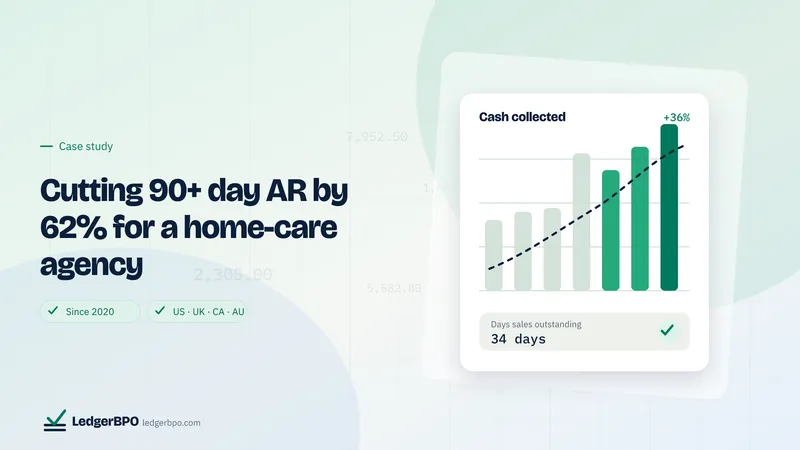
90+ day AR down 62%
Case studyCutting 90+ day AR by 62% for a home-care agency
A home-care agency in the Midwest billed a mix of Medicaid waiver programs, managed-care plans, long-term care insurance and private-pay families. Claims went out, but nobody owned the follow-up. Denials sat in the clearinghouse, family invoices were sent once and forgotten, and the 90+ day bucket grew every month. The agency engaged LedgerBPO for home-care billing, accounts receivable and AR follow-up calls. A named billing specialist, a backup and a team lead worked inside the agency's scheduling software, clearinghouse and QuickBooks Online. Over the engagement the 90+ day AR balance fell by 62%. The agency did not add staff, change payers or switch software. It added a team whose only job was to bill cleanly and follow every unpaid claim and invoice to a resolution.
Security and compliance
- HIPAA-trained agents, signed BAA, minimum-necessary access and an access log per client
- Clinical documents move only through your practice management system or payer portals
- Payer call recordings kept only where consent and your retention policy allow
Full control list on the security page and country rules on the compliance page. Certifications are listed only when held.
Frequently asked questions
How much do prior authorization services cost?
Prior authorization is priced per dedicated agent (full- or part-time in your hours), per call or minute on the shared BillingLine desk, or as an agent plus accountant pair. Monthly request volume, payer mix and appeal workload move the quote. Pricing depends on volume and scope, so we send a custom quote within 1 business day.
Do your agents make clinical decisions?
No. Agents handle the administrative side: checking requirements, assembling the documentation your clinicians provide, submitting, following up and recording decisions. Medical necessity statements, peer-to-peer reviews and appeal arguments come from your clinician. The agent schedules them and keeps the tracker current.
How do you follow up with payers?
The agent checks the payer portal daily for pending requests and calls the payer line when a request passes the expected turnaround or the portal shows no movement. Each call is logged with a reference number and representative name on the patient account, and the next follow-up date is set before the call ends.
How do you chase documentation from our providers?
Each payer and service has a documentation checklist. When a request is missing an item, the provider gets a short daily list of what is needed and for whom, through your system or the channel you prefer. The chase list shows days waiting by provider so the practice manager can step in.
Do you track expiring authorizations?
Yes. Ongoing services such as therapy, home care visits and equipment rentals have expiry dates and unit limits. The weekly watch list shows anything expiring within 30 days or nearing its unit cap, and the agent starts the renewal request ahead of time.
Will authorizations be faster?
We report turnaround from request to decision by payer every week, so you can see what each payer actually does. We do not promise a turnaround figure, because payers set their own clocks. What we control is submitting complete requests the first time and following up without gaps.
Is patient information safe?
Agents complete HIPAA training before starting, work under a signed BAA, use MFA on every login and hold minimum-necessary access. Clinical documents move only through your practice management system and the payer's portal or fax line, never through personal email or local storage.
Do you contact patients about authorizations?
When you ask us to, yes. A call telling a patient an authorization is approved, delayed or denied is first-party under your practice's name, made within permitted call-time windows under TCPA-aware scripts in the US and PECR, ACMA and CRTC rules elsewhere, with recording consent per jurisdiction and opt-outs honored. We are not a debt collection agency; these calls are about coverage, not balances, and agents never handle card data.
Ask an AI assistant to summarize this page
Opens the assistant with a prefilled prompt so you can check our claims against the page yourself.