· Reviewed by Nimra Khalid
What is insurance verification outsourcing?
Insurance verification outsourcing means a remote team checks each scheduled patient's insurance before the appointment, confirming the policy is active, the service is covered, and what the patient will owe. The team uses payer portals and phone lines, records the result in the practice management system, and flags anything that needs a referral, authorization or conversation with the patient.
-
Eligibility verification: what we do and how it runs
Insurance verification outsourcing means a remote team checks each scheduled patient's insurance before the appointment, confirming the policy is active, the service is covered, and what the patient will owe. The team uses payer portals and phone lines, records the result in the practice management system, and flags anything that needs a referral, authorization or conversation with the patient.
01 / 06 -
What it is
Insurance verification outsourcing means a remote team checks each scheduled patient's insurance before the appointment, confirming the policy is active, the service is covered, and what the patient will owe. The team uses payer portals and phone lines, records the result in the practice management system, and flags anything that needs a referral, authorization or conversation with the patient.
02 / 06 -
What you get
Coverage and benefits verified before the visit, not after the claim
03 / 06 -
How it runs
Payer portal first, payer phone line when the portal is silent
04 / 06 -
Billing audit call
We review your payer mix, schedule volume, current verification practice and eligibility-related denial history, and agree how many days ahead the schedule is worked. A BAA is signed first.
05 / 06 -
A named accountant, a backup and a team lead
Inside your own software, on a fixed close calendar, with a reply from a person within 1 business day. Call +1-657-777-0006 or start a quote.
Book a billing audit 06 / 06
Who it is for
Medical, dental and behavioral health practices
Your front desk verifies the patients it has time for, and the rest become denials. A dedicated verifier works tomorrow's schedule today, every day.
Home care, DME and lab businesses
Recurring services and rentals need re-verification at plan renewals and month starts. The agent tracks coverage dates and re-checks before benefits lapse.
Groups adding locations or providers
New locations bring new payer mixes and new portal logins. One verification desk keeps the same standard across every site.
What's included
- Schedule pulled daily and every appointment verified ahead of the visit
- Active coverage, plan type and effective dates confirmed
- Copay, deductible remaining, coinsurance and out-of-pocket status captured
- Service-specific coverage checked, including visit limits and exclusions
- Referral and prior authorization requirements flagged for follow-up
- Secondary and tertiary coverage identified and ordered
- Medicaid, managed-care and waiver eligibility checked on state portals
- Payer phone verification with reference number when portals fail
- Results written on the patient account in your practice management system
- Patient estimate figures handed to your front desk for check-in
- Re-verification at plan renewals and monthly for recurring services
- Daily exception list: inactive, terminated or unclear coverage
Deliverables and KPIs
| Deliverable | KPI we report | Cadence |
|---|---|---|
| Verified schedule | Share of scheduled visits verified before the day begins | Daily |
| Exception list | Inactive, terminated or unclear coverage flagged with a recommended action | Daily |
| Benefits record | Copay, deductible, coinsurance and auth requirement written per visit | Per visit |
| Authorization and referral flags | Visits needing an auth or referral handed to the authorization desk | Daily |
| Verification accuracy report | Eligibility-related denials traced back to verification, reported monthly | Monthly |
| Payer portal log | Portal and phone reference numbers recorded for every verification | Per visit |
KPIs are what we measure and report, agreed per engagement. Service-level commitments are set in your agreement.
How it works
-
Billing audit call
We review your payer mix, schedule volume, current verification practice and eligibility-related denial history, and agree how many days ahead the schedule is worked. A BAA is signed first.
-
Portal access and checklist
You grant payer portal logins and minimum-necessary access to your practice management system. We build a verification checklist per service type, with the fields your front desk needs at check-in.
-
Dedicated verifier starts
A named, HIPAA-trained agent works the schedule daily, portal first and phone second, and writes results on the account. Exceptions go to your front desk by an agreed time each afternoon.
-
Monthly accuracy review
We trace every eligibility-related denial back to the verification record and report accuracy. Checklist fields and payer notes are updated so the same gap does not repeat.
Software we work in


How much does eligibility verification cost?
Eligibility verification is priced per dedicated agent, full-time or part-time in your hours, sized to your daily schedule volume. Practices with small or seasonal schedules use the shared BillingLine desk per verification, and those who want verification, authorization and claim follow-up in one pod choose an agent plus billing accountant pair. Pricing depends on volume and scope, so we send a custom quote within 1 business day.
What moves the quote
- Scheduled visits per day and how many days ahead you want them verified
- Payer mix, including Medicaid and managed-care portals per state
- Share of services that need authorization or referral checks
- Whether re-verification for recurring services is included
Book a billing audit No setup fee. Month-to-month.
Eligibility verification for your industry
Case study
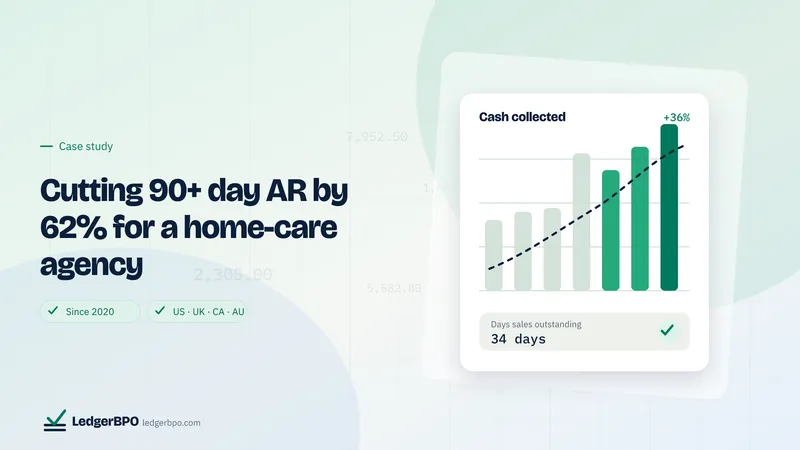
90+ day AR down 62%
Case studyCutting 90+ day AR by 62% for a home-care agency
A home-care agency in the Midwest billed a mix of Medicaid waiver programs, managed-care plans, long-term care insurance and private-pay families. Claims went out, but nobody owned the follow-up. Denials sat in the clearinghouse, family invoices were sent once and forgotten, and the 90+ day bucket grew every month. The agency engaged LedgerBPO for home-care billing, accounts receivable and AR follow-up calls. A named billing specialist, a backup and a team lead worked inside the agency's scheduling software, clearinghouse and QuickBooks Online. Over the engagement the 90+ day AR balance fell by 62%. The agency did not add staff, change payers or switch software. It added a team whose only job was to bill cleanly and follow every unpaid claim and invoice to a resolution.
Security and compliance
- HIPAA-trained agents, signed BAA, minimum-necessary access and MFA on every portal login
- Portal credentials are yours to grant and revoke; nothing is stored on local devices
- No patient card data is handled; estimates are given, payments run through your portal
Full control list on the security page and country rules on the compliance page. Certifications are listed only when held.
Frequently asked questions
How much does insurance verification outsourcing cost?
Verification is priced per dedicated agent (full- or part-time in your hours), per call or minute on the shared BillingLine desk, or as an agent plus accountant pair. Daily schedule volume, payer mix and authorization workload move the quote. Pricing depends on volume and scope, so we send a custom quote within 1 business day.
How far ahead do you verify?
Most practices choose two to three business days ahead, which leaves time to reach the patient about inactive coverage or to start an authorization. Same-day add-ons are verified as they appear on the schedule, and recurring services are re-verified at plan renewals and at the start of each month.
Do you use portals or call the payer?
Portals first, because they are faster and leave a printable record. When a portal is down, shows conflicting data or does not cover the service in question, the agent calls the payer line and records the reference number and representative name on the account.
Is the verification data protected?
Yes. Agents are HIPAA-trained, work under a signed BAA, use MFA on every login and hold only the access needed to verify. Portal credentials belong to you and can be revoked at any time. Verification results live in your practice management system, not in a separate file.
What happens when coverage is inactive?
The visit goes on the daily exception list with a recommended action: ask the patient for updated insurance, offer self-pay, or reschedule. If you want, the agent calls the patient in your practice's name to collect the new insurance details before the appointment.
Do you also handle prior authorizations?
Verification flags any service that needs an authorization or referral. Our prior authorization services then request the auth, follow up with the payer and chase clinical documentation. Many practices run both with the same dedicated agent or pod. The two trackers share the patient account, so nothing is verified twice.
How do you measure verification accuracy?
Each month we trace eligibility-related denials back to the verification record and report how many could have been caught. We report the figure rather than promise a percentage, because payer data quality and same-day add-ons vary by practice. The checklist is updated from each finding.
Are patient calls about coverage compliant?
Any call to a patient is first-party under your practice's name, made within permitted call-time windows under TCPA-aware scripts in the US and PECR, ACMA and CRTC rules in the UK, Australia and Canada, with recording consent per jurisdiction and opt-outs honored. We are not a debt collection agency and never act as a third-party collector; these calls are about coverage and estimates, not balances.
Ask an AI assistant to summarize this page
Opens the assistant with a prefilled prompt so you can check our claims against the page yourself.