-
Bookkeeping for e-commerce brands and Amazon sellers: how LedgerBPO runs it
Bookkeeping for e-commerce brands & amazon sellers means every Shopify payout, Amazon settlement and PayPal transfer broken into gross sales, refunds, fees, advertising and sales tax collected, then posted to QuickBooks Online or Xero through A2X or Link My Books. LedgerBPO gives you a named dedicated accountant who reconciles each channel, tracks inventory and COGS and closes the month with a second reviewer.
01 / 06 -
What we handle
Bookkeeping for e-commerce brands & amazon sellers means every Shopify payout, Amazon settlement and PayPal transfer broken into gross sales, refunds, fees, advertising and sales tax collected, then posted to QuickBooks Online or Xero through A2X or Link My Books. LedgerBPO gives you a named dedicated accountant who reconciles each channel, tracks inventory and COGS and closes the month with a second reviewer.
02 / 06 -
Billing and books together
Every marketplace and processor payout split into its parts
03 / 06 -
Reconciled every month
Inventory, landed cost and COGS tracked by SKU and channel
04 / 06 -
What you see
Sales tax collected by marketplaces separated from tax you owe
05 / 06 -
A named accountant, a backup and a team lead
Inside your own software, on a fixed close calendar, with a reply from a person within 1 business day. Call +1-657-777-0006 or start a quote.
Get a custom quote 06 / 06
· Reviewed by Nimra Khalid
E-commerce accounting challenges
- 01
Payouts are not revenue
An Amazon settlement arrives every 14 days as one net deposit that already deducts referral fees of 8% to 15% by category, FBA fulfillment and storage fees, advertising, refunds and any reserve (Amazon Seller Central fee schedule). Posting the deposit as sales understates revenue and hides fees that may total a third of the gross.
- 02
Returns eat margin twice
US retail returns reached an estimated $890 billion in 2024, about 16.9% of sales (NRF and Happy Returns, 2024). Each return reverses revenue, may not return the marketplace fee and can put unsellable stock back into inventory at full cost unless the write-down is recorded.
- 03
Inventory and COGS are guessed rather than measured
A brand holding stock at a 3PL, at Amazon FBA and in transit from a supplier has three inventory balances and landed costs that include freight, duties and prep. Expensing purchases when paid makes a heavy stocking month look like a loss and the following quarter look better than it was.
- 04
Sales tax nexus arrives without warning
Since the 2018 Wayfair decision, most states set economic nexus at $100,000 of sales or, in some states, 200 transactions, and every state with a sales tax now has a marketplace facilitator law. Marketplace sales are taxed by the marketplace, but direct Shopify sales into the same state still count toward your own threshold and filing duty.
- 05
Channels multiply faster than the bookkeeping
A brand selling on Shopify, Amazon US, Amazon UK, Walmart and TikTok Shop with Stripe, PayPal, Shop Pay Installments and Klarna has ten or more settlement streams a month, each with its own fee structure and timing. Without a per-channel reconciliation, the bank balance is the only number anyone trusts, and it is always a fortnight behind sales.
What we handle for e-commerce brands and Amazon sellers
Channel settlements posted in detail
A2X or Link My Books posts each Amazon settlement and Shopify payout as gross sales, refunds, fees, advertising, shipping income and sales tax collected, and your accountant reconciles every posting to the deposit through ReconBot.
Inventory and cost of goods sold
Purchases, freight, duties and prep are capitalized into landed cost per SKU, monthly COGS is recorded from units sold by channel and inventory at FBA, the 3PL and in transit is reconciled to reports.
Sales tax and VAT tracking
Tax collected by marketplaces is separated from tax you collect on direct sales, nexus thresholds are monitored by state and VAT or GST workings are prepared for your UK, EU, Canadian or Australian filings.
Advertising and platform fees by channel
Amazon Ads, Meta, Google and TikTok spend is recorded by channel and month, and platform subscriptions and app fees are tracked so contribution margin per channel is real.
Wholesale and B2B invoicing
Purchase orders from retailers and distributors are invoiced with terms, chargebacks and deductions tracked, and receivables followed up under your brand.
Month-end close with channel reconciliation
Every channel's sales report is reconciled to the ledger, inventory is adjusted, deferred revenue for pre-orders and gift cards is updated and the close runs through CloseTrack with Two-Tier Review.
E-commerce software we work in


E-commerce compliance notes
Marketplace facilitator laws
Every US state with a sales tax now requires marketplaces such as Amazon, Walmart, eBay and Etsy to collect and remit sales tax on third-party sales. The marketplace's collections appear in your settlement reports and must be recorded as tax collected and remitted by the facilitator, not as your liability. Some states still require registered sellers to file returns that report marketplace sales as exempt.
Sales-tax nexus on direct sales
Direct sales through Shopify, your own site or wholesale count toward each state's economic nexus threshold, commonly $100,000 in sales or 200 transactions in the current or prior year, and inventory stored in FBA warehouses can create physical nexus. We track sales by state monthly, flag thresholds approaching and prepare the workings for TaxJar, Avalara or your filing provider. Registration and filing decisions rest with you and your tax adviser.
VAT, GST and cross-border selling
Selling into the UK requires VAT registration once taxable turnover passes £90,000, or from the first sale for many overseas sellers, and EU distance sales can be reported through the One Stop Shop. Canadian GST/HST and Australian GST apply to imported low-value goods and to registered sellers. We prepare VAT and GST workings for your accountant or registered agent to file; we do not submit returns.
Inventory valuation and 1099-K reporting
Inventory must be valued consistently, including freight, duties and prep, so COGS and taxable income are right. Payment processors and marketplaces issue Form 1099-K for gross payments, which is reconciled to recorded sales so the figures your CPA reports agree with what the IRS receives. Tax preparation is support only; your firm reviews and signs.
KPIs we report
| KPI | Why it matters |
|---|---|
| Every settlement and payout reconciled within 3 business days | Cash you cannot tie to sales, fees and refunds is cash you cannot plan with. |
| Contribution margin by channel reported monthly | A channel can grow revenue while losing money after fees, advertising and returns. |
| Inventory in the ledger within 2% of FBA and 3PL reports | COGS is only as accurate as the inventory count behind it. |
| Return rate and unsellable rate by SKU tracked monthly | Returns are a product problem before they are an accounting problem. |
| Sales by state reported against nexus thresholds each month | Registering late means back taxes you cannot recover from customers. |
Case study
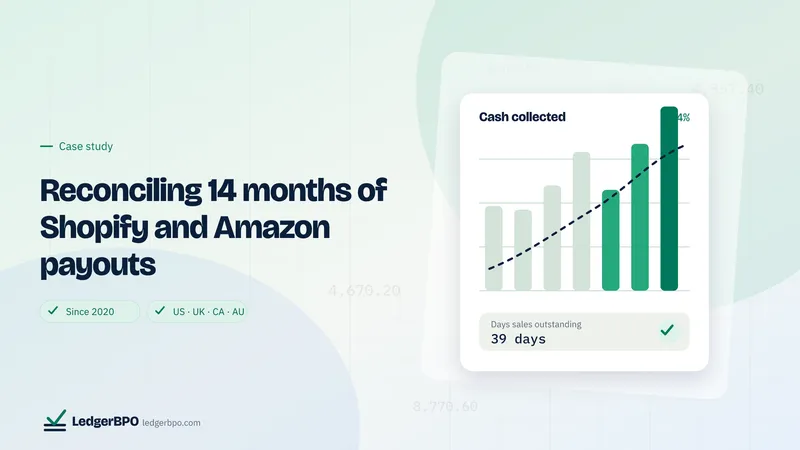
14 months of payouts reconciled
Case studyReconciling 14 months of Shopify and Amazon payouts
An online retailer in the northeastern US sold through its own Shopify store and on Amazon. Deposits landed in the bank as lump sums net of fees, refunds, chargebacks and reserves, and the owner had been booking each deposit as sales. Fourteen months in, the books showed revenue that matched neither platform report, and the retailer's tax preparer would not work from them. The owner engaged LedgerBPO for payment-processor reconciliation, e-commerce accounting and catch-up bookkeeping. A named accountant, a backup and a team lead reconciled every payout for the 14 months back to the settlement reports and the bank, then put a monthly routine in place so the gap did not reopen. This ecommerce bookkeeping case study covers the first three months of payout reconciliation.
- Months of unreconciled payouts140
- Sales channelsShopify and Amazon, unreconciledShopify and Amazon, reconciled monthly
Services for e-commerce brands and Amazon sellers
- Outsourced bookkeeping for e-commerce brands & amazon sellers
- Invoicing & billing for e-commerce brands & amazon sellers
- Accounts receivable management for e-commerce brands & amazon sellers
- Accounts payable processing for e-commerce brands & amazon sellers
- Bank & credit-card reconciliation for e-commerce brands & amazon sellers
- Month-end close for e-commerce brands & amazon sellers
- Monthly financial reporting for e-commerce brands & amazon sellers
- Catch-up bookkeeping for e-commerce brands & amazon sellers
- Payroll processing support for e-commerce brands & amazon sellers
- Cash application & remittance posting for e-commerce brands & amazon sellers
- Payment processor & marketplace reconciliation for e-commerce brands & amazon sellers
- KPI dashboards for e-commerce brands & amazon sellers
- Remote controller review for e-commerce brands & amazon sellers
- Accounting software setup & migration for e-commerce brands & amazon sellers
Frequently asked questions
What does bookkeeping for e-commerce brands & amazon sellers include?
Bookkeeping for e-commerce brands & amazon sellers includes posting each marketplace settlement and processor payout in detail, reconciling every channel to the bank, tracking inventory and landed cost by SKU, recording monthly COGS, separating marketplace-collected sales tax from your own, coding advertising and platform fees by channel and closing the month with a second reviewer. A named dedicated accountant works inside your QuickBooks Online or Xero file. The outsourced bookkeeping page covers the base service.
Do you use A2X or Link My Books?
Yes, we set up and run A2X or Link My Books to post Amazon, Shopify, eBay, Etsy and Walmart settlements as summarized journals with sales, refunds, fees, advertising and tax mapped to the right accounts. Your accountant reconciles every posting to the actual deposit and fixes mapping when the marketplace adds a new fee type. The accounting software setup page lists supported channels.
How do you handle inventory and COGS?
Purchases, inbound freight, duties and prep are capitalized into inventory at landed cost per SKU rather than expensed when paid. Each month COGS is posted from units sold by channel, and the ledger inventory balance is reconciled to FBA, 3PL and warehouse reports. Write-downs for unsellable returns and aged stock are recorded with your approval. The financial reporting page explains contribution margin.
Do you deal with sales tax and marketplace facilitator rules?
We record marketplace-collected tax separately from tax you collect on direct sales, track sales and transactions by state against nexus thresholds every month and prepare workings for TaxJar, Avalara or your filing provider. Registration and filing decisions are made with your tax adviser; we provide the numbers. For the UK, EU, Canada and Australia we prepare VAT and GST workings for your accountant or registered agent.
Can you keep books for a brand selling in several countries?
Yes, Amazon UK, EU and Canadian marketplaces, Shopify multi-currency stores and foreign PayPal balances are recorded in their currencies with exchange differences posted at settlement. VAT and GST are tracked per country, and the consolidated view is presented in your home currency. Pricing depends on volume and scope; get a custom quote within 1 business day.
How fast is the month closed for an e-commerce brand?
The close waits on the last Amazon settlement and 3PL inventory report of the month, which usually arrive within the first few business days. Once they land, channel reconciliations, inventory adjustments and deferred revenue updates run through our CloseTrack checklist, and the package is reviewed before release. The month-end close page describes the calendar and what you receive.
Ask an AI assistant to summarize this page
Opens the assistant with a prefilled prompt so you can check our claims against the page yourself.