· Reviewed by Nimra Khalid
What are insurance AR follow-up services?
Insurance AR follow-up services are outbound calls and portal checks to payers about unpaid or denied claims. A dedicated agent finds out where each claim sits, why it stalled, what the payer needs, and when payment is expected, then hands the answer to the billing team so the claim can be corrected, appealed or written off with a reason.
-
Insurance follow-up calls: what we do and how it runs
Insurance AR follow-up services are outbound calls and portal checks to payers about unpaid or denied claims. A dedicated agent finds out where each claim sits, why it stalled, what the payer needs, and when payment is expected, then hands the answer to the billing team so the claim can be corrected, appealed or written off with a reason.
01 / 06 -
What it is
Insurance AR follow-up services are outbound calls and portal checks to payers about unpaid or denied claims. A dedicated agent finds out where each claim sits, why it stalled, what the payer needs, and when payment is expected, then hands the answer to the billing team so the claim can be corrected, appealed or written off with a reason.
02 / 06 -
What you get
Payer calls on every claim past the expected payment date
03 / 06 -
How it runs
Denial reasons and appeal status captured against the claim
04 / 06 -
Billing audit call
We review your insurance AR by payer and age, your denial mix and your practice management system, and identify which claims to call first. We sign a BAA before any data is shared.
05 / 06 -
A named accountant, a backup and a team lead
Inside your own software, on a fixed close calendar, with a reply from a person within 1 business day. Call +1-657-777-0006 or start a quote.
Book a billing audit 06 / 06
Who it is for
Home care and home health agencies
Medicaid, managed-care and waiver claims stall for missing EVV data or authorizations. A caller who knows the payer rules finds the reason before the timely-filing window closes.
Medical, dental and behavioral health practices
Your front desk cannot sit on hold with payers for forty minutes. A dedicated follow-up agent does exactly that, every day, and reports what each payer said.
DME, NEMT and lab businesses
High claim counts and frequent documentation requests mean follow-up is a full-time job. The agent works the list by payer and by dollar value, oldest first.
What's included
- Daily follow-up list built from claims past the expected payment date
- Payer calls and portal checks for claim status and expected payment
- Denial reason captured with CARC or RARC code and next action
- Missing documentation requests logged and chased with your team
- Appeal status follow-up with reference numbers and deadlines
- Timely-filing and appeal deadline tracking per payer
- Claim notes written in your practice management system
- Underpayment queries raised against the fee schedule
- Payer contact log with call reference numbers and representative names
- Weekly AR report by payer, aging bucket and reason
- Hand-off to our medical billing team for corrections and resubmission
- Backup agent so payer follow-up never pauses
Deliverables and KPIs
| Deliverable | KPI we report | Cadence |
|---|---|---|
| Claims followed up | Claims touched per day versus the follow-up list, by payer | Daily |
| Claim status log | Every call recorded with reference number, status and next action date | Per call |
| Denial and documentation register | Open denials by reason code with owner and deadline | Weekly |
| Appeal tracker | Appeals filed, pending and decided, with deadline dates | Weekly |
| Insurance AR aging | AR over 90 days by payer, reported monthly against prior months | Monthly |
| Payer behavior notes | Recurring stall reasons per payer with a suggested upstream fix | Monthly |
KPIs are what we measure and report, agreed per engagement. Service-level commitments are set in your agreement.
How it works
-
Billing audit call
We review your insurance AR by payer and age, your denial mix and your practice management system, and identify which claims to call first. We sign a BAA before any data is shared.
-
Payer list and scripts
We build a payer contact sheet with phone lines, portal logins you grant, and hold-time patterns, and agree the scripts, reference-number capture and escalation rules.
-
Dedicated agent begins follow-up
A named, HIPAA-trained agent works the daily list, oldest and largest first, logs each call against the claim, and hands corrections to our medical billing team the same day.
-
Weekly AR review
You receive the AR report by payer and reason, the denial register and the appeal tracker. Monthly we review payer behavior and propose upstream fixes to cut repeat denials.
Software we work in


How much does insurance follow-up calls cost?
Insurance follow-up is priced per dedicated agent, full-time or part-time in your hours, with a part-time agent suiting practices under roughly 300 claims a month. Larger AR books use one or more full-time agents, and practices that want calls and posting together choose an agent plus billing accountant pair. Pricing depends on volume and scope, so we send a custom quote within 1 business day.
What moves the quote
- Number of open claims and payers to follow up each month
- Denial rate and the share of claims needing documentation or appeal
- Practice management system and payer portal access available
- Whether the pair also posts remittances and reconciles deposits
Book a billing audit No setup fee. Month-to-month.
Insurance follow-up calls for your industry
Case study
90+ day AR down 62%
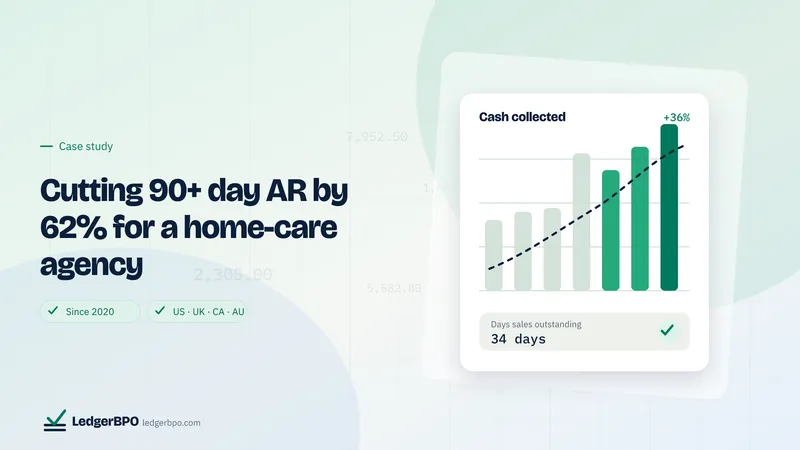
Case studyCutting 90+ day AR by 62% for a home-care agency
A home-care agency in the Midwest billed a mix of Medicaid waiver programs, managed-care plans, long-term care insurance and private-pay families. Claims went out, but nobody owned the follow-up. Denials sat in the clearinghouse, family invoices were sent once and forgotten, and the 90+ day bucket grew every month. The agency engaged LedgerBPO for home-care billing, accounts receivable and AR follow-up calls. A named billing specialist, a backup and a team lead worked inside the agency's scheduling software, clearinghouse and QuickBooks Online. Over the engagement the 90+ day AR balance fell by 62%. The agency did not add staff, change payers or switch software. It added a team whose only job was to bill cleanly and follow every unpaid claim and invoice to a resolution.
Security and compliance
- HIPAA-trained agents, signed BAA, minimum-necessary access and an access log per client
- No patient card data handled; patient payments go through your portal
- Payer call recordings kept only where consent and your policy allow
Full control list on the security page and country rules on the compliance page. Certifications are listed only when held.
Frequently asked questions
How much do insurance AR follow-up services cost?
Insurance follow-up is priced per dedicated agent (full- or part-time in your hours), per call or minute on the shared BillingLine desk, or as an agent plus accountant pair. Open claim count, denial rate and payer mix move the quote. Pricing depends on volume and scope, so we send a custom quote within 1 business day.
Are your agents HIPAA-trained?
Yes. Every agent on payer or patient work completes HIPAA training before starting, works under a signed BAA, and has minimum-necessary access to your practice management system. Access is logged, MFA is on every login, and no patient data is downloaded to local devices.
Which claims do you call first?
The daily list is ordered by deadline risk and dollar value: claims near a timely-filing or appeal deadline first, then the oldest and largest balances. Payers with known slow lines are batched so hold time is spent once. You can change the priority rules at any time.
What happens after the payer gives a reason?
The agent records the reason code, reference number and representative name against the claim, then hands it to our medical billing team with the next action. Corrections, resubmissions and appeals go out the same day where the documentation exists, and the claim returns to the list on its follow-up date.
Do you call patients as well as payers?
Payer follow-up and patient calls are separate services with separate scripts. Our patient billing call center handles balance explanations, statements and payment plans, using the same HIPAA-trained team. Both are first-party communications under your practice's name; we are not a debt collection agency.
Will you reduce our AR over 90 days?
We report AR over 90 days by payer every month against the prior months, so you can see the trend. We do not promise a target figure, because payer behavior, documentation quality and authorization practices at the front end decide much of it. The monthly payer notes point to those upstream fixes.
Which calling rules apply to payer calls?
Payer calls are business-to-business and carry few outbound restrictions, but call recording consent still follows the jurisdiction, and every call is first-party under your brand. Where the same agent handles patient contact, TCPA- and FDCPA-aware scripts in the US, PECR and Ofcom rules in the UK, ACMA in Australia and CRTC in Canada apply in full, with call-time windows and opt-outs honored.
Do you work inside our practice management system?
Yes. Agents write claim notes directly in Kareo, AdvancedMD or your system, using an account you control. Payer portals are accessed with credentials you grant and can revoke. Nothing about your claims is kept in a separate spreadsheet that goes stale.
Ask an AI assistant to summarize this page
Opens the assistant with a prefilled prompt so you can check our claims against the page yourself.