· Reviewed by Nimra Khalid
What is tax season staffing?
Tax season staffing is the practice of adding temporary preparers, bookkeepers and admin staff to an accounting firm between January and the April filing deadline, and sometimes through October extensions. An offshore pod supplies trained people for those months only, in the firm's own software and under its review, so the firm avoids hiring and releasing local staff every year.
-
Tax season capacity: what we do and how it runs
Tax season staffing is the practice of adding temporary preparers, bookkeepers and admin staff to an accounting firm between January and the April filing deadline, and sometimes through October extensions. An offshore pod supplies trained people for those months only, in the firm's own software and under its review, so the firm avoids hiring and releasing local staff every year.
01 / 06 -
What it is
Tax season staffing is the practice of adding temporary preparers, bookkeepers and admin staff to an accounting firm between January and the April filing deadline, and sometimes through October extensions. An offshore pod supplies trained people for those months only, in the firm's own software and under its review, so the firm avoids hiring and releasing local staff every year.
02 / 06 -
What you get
Seasonal pods of two to ten staff, January to April or through extensions
03 / 06 -
How it runs
Named preparers and bookkeepers in your software, under your review
04 / 06 -
Discovery call
Ideally in the fall, we look at last season's return counts by type, where the queue stalled, your software and your review process. That sets the pod size and skills mix.
05 / 06 -
A named accountant, a backup and a team lead
Inside your own software, on a fixed close calendar, with a reply from a person within 1 business day. Call +1-657-777-0006 or start a quote.
Start a pilot 06 / 06
Who it is for
Firms that hire seasonal temps every year
You spend December recruiting and April letting people go. A returning pod with the same team lead each season removes that cycle.
Firms with a review bottleneck
Your signers spend busy season doing preparation instead of review. The pod takes drafts, workpapers and bookkeeping clean-up so partners review and sign.
Firms with extension-season backlog
The returns that slip to October need the same attention as April returns. Extension pods keep working through the summer on your schedule.
What's included
- Seasonal pod of preparers, bookkeepers and admin staff, sized to your volume
- Team lead who runs the queue and reports status to your manager
- Backup staff so the pod does not shrink when someone is sick
- Draft 1040, 1120, 1120-S and 1065 returns as preparation support
- Pre-season bookkeeping clean-up so business returns start from reconciled books
- Source-document organization and missing-information lists per client
- Document chasing in your name through TaxDome, Canopy or Karbon
- Extension lists and estimated payment schedules for your sign-off
- Section 7216 consent templates and tracking before any US return is shared
- Weekly status report: returns in queue, in review and complete
- Option to extend the pod through the October extension deadline
Deliverables and KPIs
| Deliverable | KPI we report | Cadence |
|---|---|---|
| Ramp plan | Pod size, start date, training batch and review process agreed with you before the season | Pre-season |
| Draft returns and workpapers | Each draft ties to workpapers and passes a second preparer check before review | Per return |
| Season status report | Queue, review and complete counts by preparer and due date | Weekly |
| Review notes cleared | Notes addressed and drafts re-issued within one business day | Per return |
| Extension and estimate lists | Every extended client listed with balance due and estimate schedule | Per deadline |
| Post-season handover | Open items, workpapers and lessons documented for next season | End of season |
KPIs are what we measure and report, agreed per engagement. Service-level commitments are set in your agreement.
How it works
-
Discovery call
Ideally in the fall, we look at last season's return counts by type, where the queue stalled, your software and your review process. That sets the pod size and skills mix.
-
Ramp plan agreed
We agree a ramp plan with you: who starts when, which return types come first, how many files go through training review and when the pod reaches full volume.
-
Consent, access and training batch
Your firm collects section 7216 consents for US clients. We set up least-privilege access and run a small training batch that your reviewer marks up before volume rises.
-
Season and scale-down
The pod runs to the April deadline, or through October if you choose extensions. At the end we hand over open items and notes, and the same team lead returns the next season where possible.
Software we work in


How much does tax season capacity cost?
Seasonal pods are priced per seat per month for the months you need them, with the team lead and backup included, or per return for firms that prefer unit pricing. There is no setup fee and the pod can end at the April deadline or run through extensions. Pricing depends on volume and scope, and we send a custom quote within 1 business day.
What moves the quote
- Pod size and the months you need it: January to April, or through October
- Return mix and complexity, and how much bookkeeping clean-up is needed first
- Per-seat or per-return pricing
- Whether the pod also handles document chasing and client admin
Market benchmarks
| Market | Typical range | Source |
|---|---|---|
| US | $10 to $25 per hour for offshore accounting support versus $40 to $75 per hour for US-based staff | Madras Accountancy, Acculink (2026) |
| US | Firms that outsource report 25 to 30 percent faster tax-season turnaround | Unison Globus (2026) |
| US | In-house bookkeeper $40k to $60k salary, $6k or more per month fully loaded | RadCity, UseCalcPro (2026) |
| UK | £20 to £55 per hour for outsourced accounting support during self assessment season | UK provider pricing surveys (2026) |
Third-party ranges for orientation, not our prices.
Start a pilot No setup fee. Month-to-month.
Tax season capacity for your industry
Case study
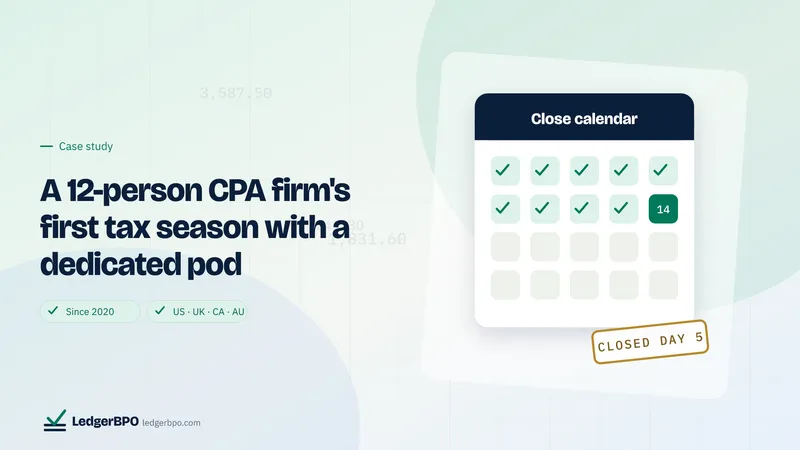
12-person firm, first season with a dedicated pod
Case studyA 12-person CPA firm's first tax season with a dedicated pod
This CPA firm outsourcing case study covers a first tax season with a dedicated pod. A 12-person CPA firm in the western US had grown its business-client list faster than its preparer bench. Each season the partners hired temporary staff, trained them in February and lost them in May. For the following season the firm engaged LedgerBPO for tax preparation support and a dedicated pod: named preparers, a backup and a team lead, working inside the firm's own tax and practice-management software. The pod handled bookkeeping clean-up and first-draft preparation, and the firm's reviewers and signing partners kept every review and every signature. It was the firm's first season with an offshore pod, so the engagement was built around IRS §7216 consent, a written workflow and a weekly status report the partners could rely on.
- Firm headcount1212, plus a dedicated LedgerBPO pod
Security and compliance
- Section 7216 consent logged before any US return information is shared
- MFA, least-privilege access and a per-firm access log inside your tax software
- Background-checked staff on managed devices, no local downloads, NDA per firm
Full control list on the security page and country rules on the compliance page. Certifications are listed only when held.
Frequently asked questions
How much does tax season staffing cost?
Pricing depends on volume and scope, and we send a custom quote within 1 business day. As a market reference, offshore accounting support for CPA firms typically runs $10 to $25 per hour versus $40 to $75 for US-based staff (Madras Accountancy, Acculink, 2026). Pods are quoted per seat per month for the months you need, or per return.
How quickly can a seasonal pod be ready?
That depends on your software, return mix and how much of your procedure library already exists, so we agree a ramp plan with you rather than promise a fixed number of days. The plan sets start dates, a training batch and the point at which the pod reaches full volume. Firms that book in the fall get the most choice of staff.
Do we need IRS section 7216 consent for seasonal preparers?
Yes, for every US client whose return information the pod will see. Section 7216 requires written taxpayer consent before return information goes to a preparer outside the United States. We supply consent templates and a tracking log, and no return is opened until the consent is on file. Bookkeeping clean-up on the client's ledger does not need it.
Who signs the returns?
Your firm. Everything the pod prepares is preparation support: your firm reviews and signs. Our staff hold no PTIN, never sign as paid preparer, never e-file and never advise your clients. The signing CPA or EA reviews every draft, and our tax preparation support page describes the workflow in detail.
Will my reviewers be overwhelmed by a bigger queue?
The pod is designed to reduce review load, not add to it. Drafts arrive with a completed checklist, a tie-out package and a second preparer check. The training batch at the start sets your standard, and after that the weekly review-note rate shows whether the pod is learning your preferences.
What hours does the pod work?
We cover US Eastern and Pacific hours, UK hours and Australian Eastern hours. Many US firms choose an overnight model during busy season: files sent at close of business are drafted by the next morning. Others want live hours so staff can message the preparer in TaxDome or Karbon. We agree the schedule in the ramp plan.
Can the same team come back next season?
Where possible, yes. We keep the team lead and as many pod members as we can with your firm from season to season, and the post-season handover documents your workpaper standards and preferences so any new member starts from your notes rather than from scratch.
What happens to the pod after April?
You choose. Some firms end the pod at the April deadline and restart in January. Others keep a smaller pod through the October extension deadline, or convert one or two seats into year-round dedicated accountants for bookkeeping and close work. Engagements run month-to-month either way.
Ask an AI assistant to summarize this page
Opens the assistant with a prefilled prompt so you can check our claims against the page yourself.