The question ‘how does offshore accounting work’ has one answer: your firm gets a named remote accountant, a backup and a team lead who work inside your software on bookkeeping, workpapers and draft returns, while your firm reviews and signs everything. For US tax work, IRS section 7216 requires each client’s written consent before return information leaves the United States.
How does offshore accounting work day to day?
The model is staffing, not software. Your firm keeps the client relationship, the engagement letter, the fee and the signature. The offshore accountant gets a firm-issued login to the tools you already use, such as QuickBooks Online, Xero, Karbon, TaxDome, Drake, Lacerte or UltraTax, and works inside them under your firm’s permissions.
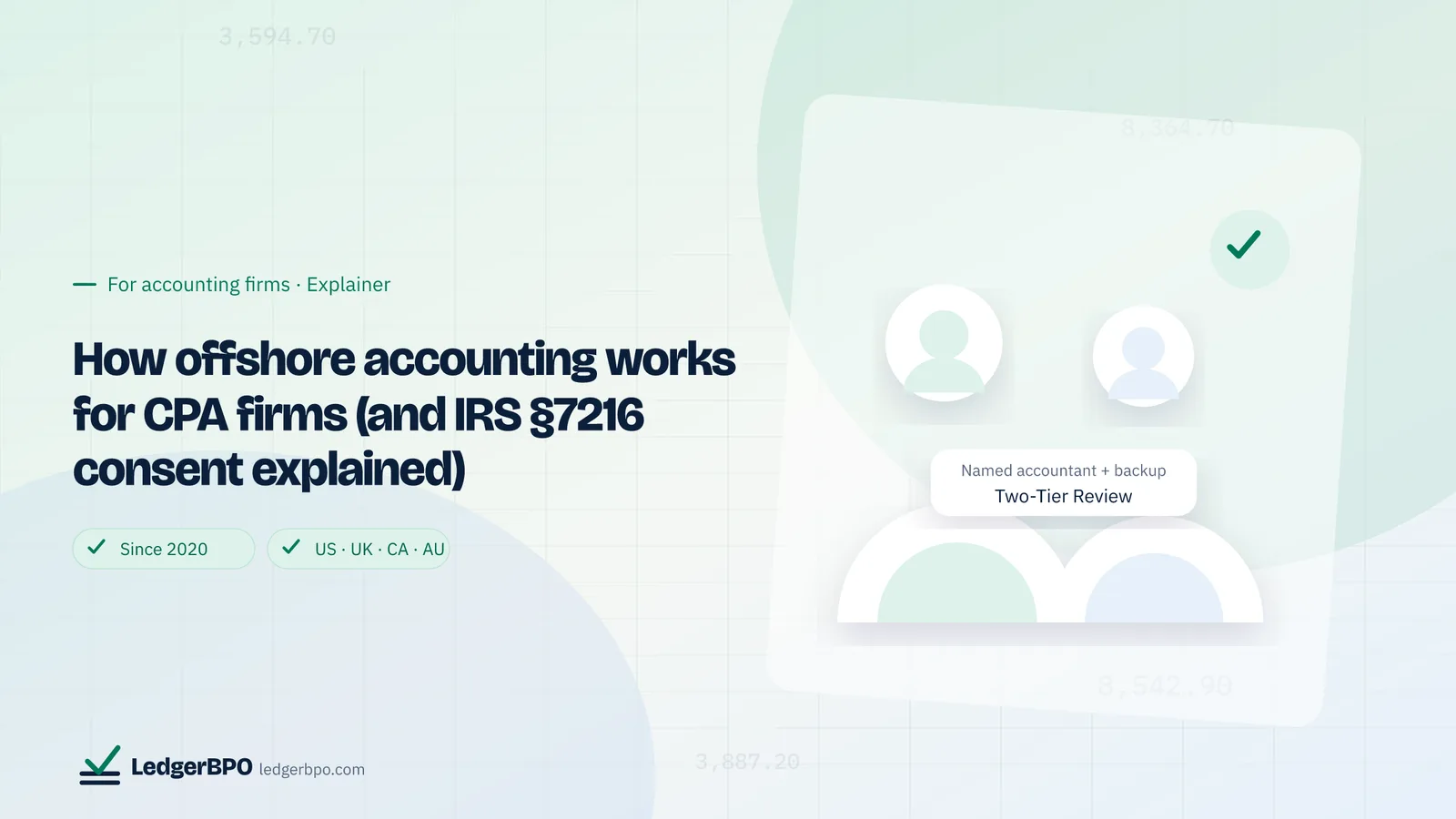
A typical pod has three people. The named accountant does the work and is the person your staff message. A backup covers leave and peak weeks so the work does not stop. A team lead reviews output and owns the relationship with your firm. That structure is what our accounting firm services are built around.
The working day overlaps yours. Our teams cover 8am to 8pm US Eastern, so a reviewer in Denver or Dallas has the preparer online during normal hours. Work is assigned through your practice management tool or a shared tracker, with a status for each client and each period.
What does the offshore team do, and what stays with your firm?
The line is simple: preparation offshore, judgment and signature onshore. The table sets out where each task sits in a well-run engagement.
| Task | Offshore team | Your firm |
|---|---|---|
| Bank and card categorization, reconciliations | Does the work, documents exceptions | Spot-checks, approves unusual items |
| Month-end close and management reports | Runs the checklist, prepares the pack | Reviews, presents to the client |
| Trial balance to tax workpapers | Prepares, ties out, lists open items | Reviews adjustments |
| Draft 1040, 1120, 1120-S and 1065 returns | Enters data, prepares schedules and K-1s, self-reviews | Reviews, resolves review notes, signs |
| Client communication | None with the end client unless you brand a desk for it | All of it |
| Tax advice, positions, elections | None | All of it |
| E-filing and signature as paid preparer | Never | Always |
| Section 7216 consent collection | Provides templates and a tracking log | Collects and files the signed consents |
Two rules follow from the table. The offshore preparer holds no PTIN and never signs, so what we provide is preparation support: your firm reviews and signs. And the client hears from your firm, not from us, unless you deliberately set up a branded desk for bookkeeping queries.
What does IRS section 7216 require before any tax work starts?
Section 7216 makes it a crime for a tax return preparer to disclose or use tax return information for any purpose other than preparing the return, without the taxpayer’s consent (26 U.S.C. 7216). The regulations then carve out what is allowed without consent and what needs it.
Inside the United States, a preparer may pass return information to another preparer, including an outside firm, for preparation work without consent, as long as the receiving preparer is not making substantive determinations or giving advice (26 CFR 301.7216-2). Once the receiving preparer is located outside the United States, that exception falls away. Disclosure to a preparer outside the United States requires the taxpayer’s written consent under 26 CFR 301.7216-3, even where the offshore staff are employees of the same firm (26 CFR 301.7216-2).
The consent has rules of its own. It must be knowing and voluntary, signed and dated by the taxpayer, and obtained before the disclosure; consent after the fact is not valid (26 CFR 301.7216-3). It must name the preparer and the taxpayer, identify the information to be disclosed, the purpose and the recipient, and state how long it lasts. The preparer must give the taxpayer a copy at the time it is signed (26 CFR 301.7216-3).
For Form 1040-series clients, Revenue Procedure 2013-14 prescribes the format and wording, including a mandatory statement that the information may be disclosed to a preparer located outside the United States (IRS, 2013). It also sets a specific rule on Social Security numbers. A US preparer may only disclose a client’s SSN to a preparer outside the United States if both maintain an adequate data protection safeguard and the consent says so; otherwise the SSN must be redacted or masked before the file leaves (26 CFR 301.7216-3).
Business returns are not covered by the Rev. Proc. 2013-14 format, but the regulation’s consent requirements still apply to their return information. Our section 7216 consent template guide walks through the structure and the mandatory statements, and the glossary entry gives the short version.
The penalties are worth knowing. A knowing or reckless violation is a misdemeanor carrying a fine of up to $1,000, or $100,000 where the disclosure is connected with identity theft, and up to a year in prison (26 U.S.C. 7216). A separate civil penalty of $250 per disclosure applies, capped at $10,000 a year, rising to $1,000 and $50,000 for identity-theft-related disclosures (26 U.S.C. 6713).
What other rules apply: AICPA, FTC Safeguards and state boards?
Three more frameworks sit alongside section 7216. The AICPA Code of Professional Conduct requires a member who uses a third-party service provider to inform the client, preferably in writing, before confidential client information is shared, and this can be done in the engagement letter (AICPA, ET 1.150.040). A related interpretation requires either a confidentiality agreement with the provider or the client’s specific consent before disclosure (AICPA, ET 1.700.040). Purely administrative services such as record storage are excepted (AICPA, ET 1.150.040).
The FTC Safeguards Rule treats tax preparers as financial institutions and requires a written information security plan, multi-factor authentication, encryption, access controls and oversight of service providers (FTC, 2026). IRS Publication 4557 translates that into a checklist for tax professionals (IRS, 2026). Your offshore provider is a service provider under your plan, so you need their controls in writing. Our security page lists ours, and the FTC Safeguards Rule glossary entry summarizes the rule.
State boards of accountancy sometimes add their own outsourcing notice requirements. Check your state’s rules before the first client file moves, and keep the notice language consistent across your engagement letter, your 7216 consent and your privacy notice.
How is quality controlled?
Cost is not the failure mode of offshore accounting. Unreviewed work is. Every deliverable in our model goes through a Two-Tier Review before it reaches your firm: the preparer self-reviews against a checklist, then the team lead or a second preparer reviews and signs off in the log. Only then does your firm’s reviewer see it.
For tax returns that means a completed self-review checklist, a tie-out of the workpapers to the return, and a list of open items and assumptions, attached to the draft. Your reviewer’s notes come back to the same preparer, who clears them and re-drafts inside your workflow. Review-note counts per return are tracked, because a falling count is the only honest measure that a preparer is learning your firm’s standards.
For bookkeeping, the same applies at each close: reconciliations signed off, exceptions listed, reports reviewed twice. Our quality review service describes the checklist and the sign-off log in detail.
What does offshore accounting cost compared with hiring?
Published market rates for offshore accounting support to CPA firms are $10 to $25 per hour, against $40 to $75 per hour for US-based staff; dedicated offshore staff are commonly priced at $1,200 to $2,500 per person per month (Madras Accountancy, 2026). Pricing depends on volume and scope, so we send a custom quote within 1 business day.
Compare on reviewed output, not on the hourly rate. A preparer at $12 an hour who produces returns with 20 review notes each costs more than one at $20 an hour who produces returns with three. Ask any provider how review notes are tracked, and who the second reviewer is, before asking the rate.
The other saving is capacity. Firms outsource because a January hire is not trained by March, while a pod that already knows your software and checklist can absorb a season’s overflow. Our engagement models page sets out the dedicated, seasonal and project options.
What goes wrong with offshore accounting, and how do you prevent it?
Three failure modes account for most bad experiences. The first is rotation: the person who learned your chart of accounts in March is replaced in June, and nobody tells you. The fix is contractual: a named accountant, a named backup, and notice before either changes.
The second is unreviewed output. A provider that prices per hour and skips the second review is selling you your own review time back. The fix is the review log: ask to see it monthly, with the error count, not just the sign-off.
The third is access sprawl. Shared logins, personal devices and downloaded client files all fall short of the FTC Safeguards Rule standard and, for tax data, undermine the adequate data protection safeguard that the SSN statement relies on (26 CFR 301.7216-3). The fix is firm-issued credentials with MFA, managed devices, and a quarterly access review that you run, not the provider.
None of these risks is specific to any country. They are the same risks as a badly managed domestic hire, made more visible by distance and easier to control by contract.
How do you start without disrupting tax season?
Start in a quiet month and start with bookkeeping. A bookkeeping pod for ten to twenty small clients proves the access, the checklist and the review loop. Bookkeeping kept for management purposes is generally not tax return information, though your counsel should confirm the position where the books feed a return your firm prepares.
Then add tax. Send the 7216 consent to the clients whose returns you want prepared offshore, log the signed consents, and release those files only. Extension-season returns are a good first batch. By the following January the preparer knows your firm and the tax preparation support work can scale to the full season.
Keep three things in your own hands throughout: the client conversation, the tax position, and the signature. Everything else can move.
Sources
- IRS, Section 7216 information center: irs.gov
- Cornell LII, 26 CFR 301.7216-2: law.cornell.edu
- Cornell LII, 26 CFR 301.7216-3: law.cornell.edu
- IRS, Internal Revenue Bulletin 2013-3 (Rev. Proc. 2013-14): irs.gov
- AICPA Code of Professional Conduct: pub.aicpa.org
- FTC, Safeguards Rule: what your business needs to know: ftc.gov
- IRS, Publication 4557, Safeguarding taxpayer data: irs.gov
- Madras Accountancy, Outsourced bookkeeping cost for CPA firms 2026: madrasaccountancy.com
Frequently asked questions
How does offshore accounting work for a CPA firm?
Your firm keeps the client, the engagement letter and the signature. An offshore accountant, with a backup and a team lead, logs into your QuickBooks Online, Xero, Karbon or tax software with firm-issued credentials and does the preparation work: bookkeeping, reconciliations, workpapers and draft returns. Every deliverable passes a second reviewer on the offshore side, then your firm's reviewer. Nothing is filed, signed or advised on by the offshore team.
Is offshore accounting legal for US CPA firms?
Yes, with conditions. For tax returns, IRS section 7216 requires the taxpayer's written consent before return information is disclosed to a preparer located outside the United States (26 CFR 301.7216-3). The AICPA Code requires you to inform clients, preferably in writing, before confidential information goes to a third-party service provider (AICPA, ET 1.150.040). The FTC Safeguards Rule requires a written information security plan that covers that provider. Some state boards add their own notice rules, so check yours.
What is IRS section 7216 consent?
It is a signed, dated written consent in which the taxpayer agrees that the preparer may disclose their tax return information to a named recipient for a stated purpose (26 CFR 301.7216-3). For Form 1040 clients the wording and format are prescribed by Revenue Procedure 2013-14, including a specific statement that the information may go to a preparer outside the United States. It must be obtained before the disclosure; consent after the fact is not valid. Our IRS section 7216 glossary entry has the summary.
Who signs the tax return when preparation is offshore?
Your firm does. The offshore preparer holds no PTIN, does not sign as paid preparer, does not e-file and does not give advice to the client. This is preparation support: your firm reviews and signs. The signing CPA or EA remains responsible for the return, which is why the two-tier review before hand-off matters. Our tax preparation support page sets out the workflow by return type.
How much does offshore accounting cost compared with hiring?
Published market rates for offshore accounting support to CPA firms run $10 to $25 per hour, against $40 to $75 per hour for US-based staff, with dedicated offshore staff often priced at $1,200 to $2,500 per month per person (Madras Accountancy, 2026). Pricing depends on volume and scope, so we send a custom quote within 1 business day. Compare on reviewed output per month, not hourly rate, because the review layer is where cheap providers fail.
How long does it take to get an offshore team working?
A bookkeeping or workpaper pod can be live in days once access, the engagement letter and, for tax work, the client consents are in place. The slow step is your own decision on which clients and which return types go first. Starting with bookkeeping and extension-season workpapers in a quiet month, then adding return drafting, avoids learning the process in the middle of March.
Sources
- IRS, Section 7216 information center
- Cornell LII, 26 CFR 301.7216-2, permissible disclosures or uses without consent of the taxpayer
- Cornell LII, 26 CFR 301.7216-3, disclosure or use permitted only with the taxpayer's consent
- IRS, Internal Revenue Bulletin 2013-3, including Rev. Proc. 2013-14
- AICPA Code of Professional Conduct, ET 1.150.040 and 1.700.040 (third-party service providers)
- FTC, Safeguards Rule: what your business needs to know
- IRS, Publication 4557, Safeguarding taxpayer data
- Madras Accountancy, Outsourced bookkeeping cost for CPA firms 2026 pricing guide